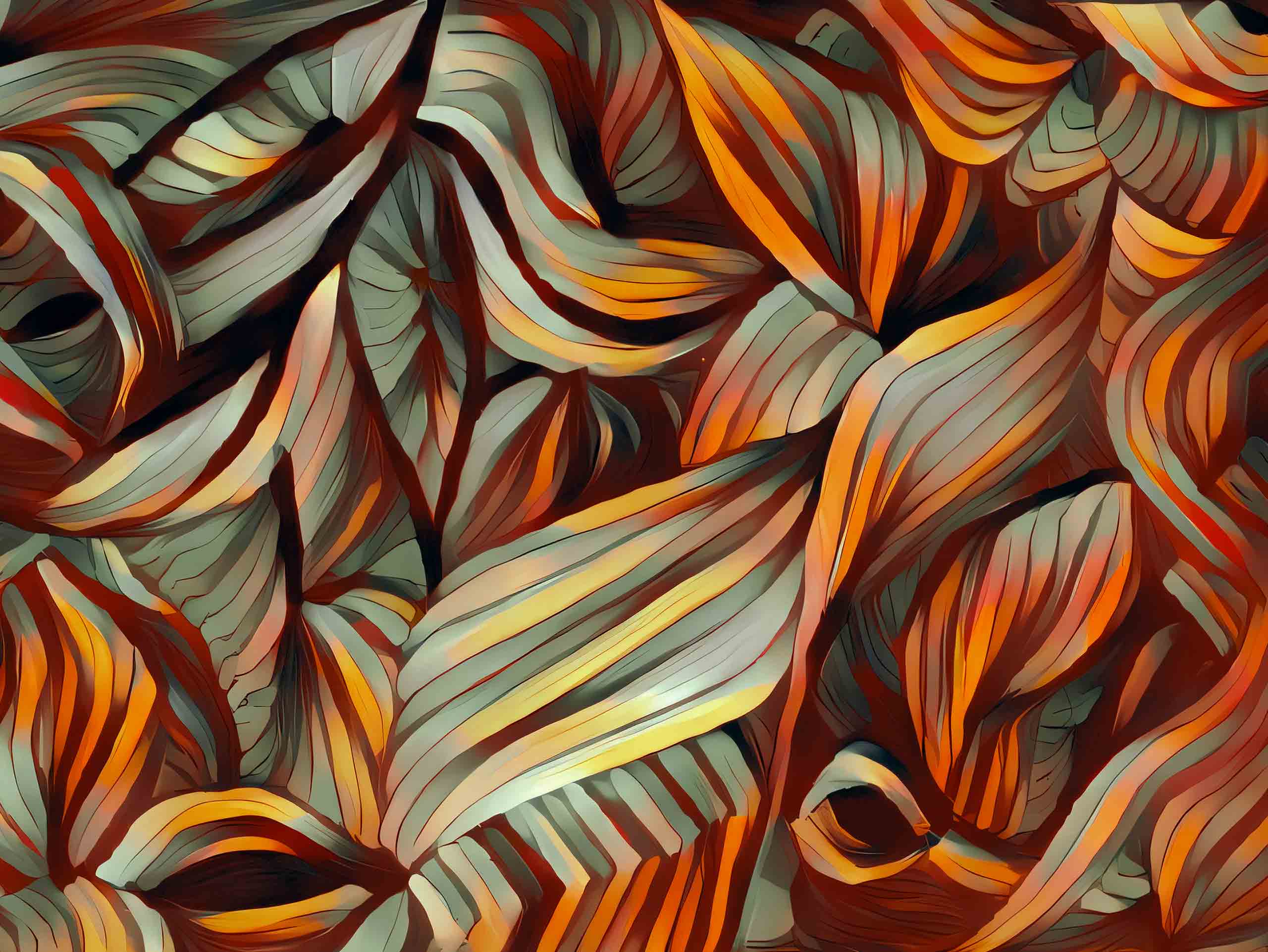

This piece drifts between ocean and earth. I chose orange-brown, ember orange, and sea-green hues—colors of soil, trunks, and leaves—to echo how forests on land and kelp forests underwater mirror one another: both are living architectures that shelter, feed, and protect. The ribbons fold like fronds in a surge, then tighten into leaf-veins and wood grain, suggesting the circularity of life that runs through tree canopies and kelp canopies alike.
Threaded through the foliage are hidden humpback eyes—quiet witnesses peering from the kelp. Their presence nods to a 2023 scientific synthesis documenting humpbacks “kelping”: seeking out floating seaweed and rolling or rubbing it along their bodies. Researchers interpret the behavior as play and skin care, a tactile ritual seen in many oceans. Here, those small eyes watch and participate, turning the kelp from backdrop into partner—a place of touch, grooming, and social ease.
My process: I start with hand-drawn waves and spectrogram-inspired line work, sketching the rhythms of whale calls and surge. Those pencil maps become layered contours that I scan and paint digitally, glazing successive passes of orange, green, and umber until the surface feels tidal and earthen at once. In the final stages I tuck small, stylized whale eyes into the fronds—little secrets that reward lingering, and the reason I call the work Whale Eyes Gazing the Kelp Forest.
Look long enough and the composition becomes a conversation between worlds: the forest textures of land meeting the underwater forest that sways with whales. In that overlap, the eyes you find are not just camouflaged details—they are invitations to notice how similar the two ecosystems really are, each one a braided community of beings that carry, nurture, feed, and protect.