


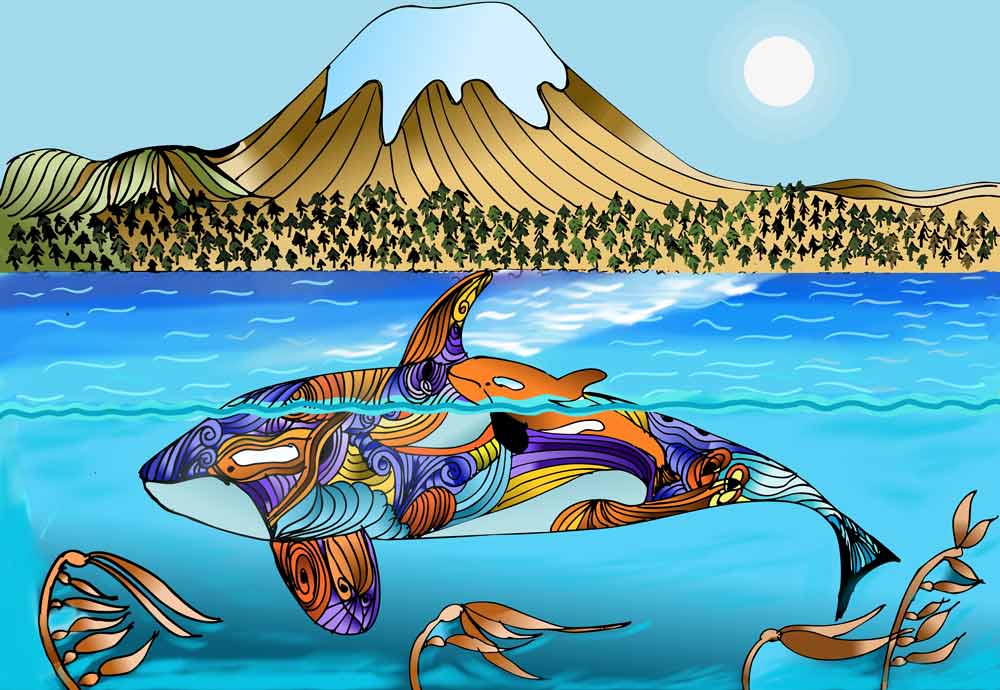

Set in an imagined Haro Strait with Mount Baker lifting above the San Juan Islands, this piece honors the bittersweet arrival of J62, a newborn in the critically endangered Southern Resident Killer Whale (SRKW) community. Kelp curls in the foreground while mother and calf slip through bands of luminous blue, grounding the scene in the Salish Sea.
The patterned surfaces are drawn from whale sounds—motifs inspired by spectrograms and echo-like waves. Look closely and you’ll see whale sound waves/patterns reflected across the mother’s body, a visual metaphor for how sound inhabits and defines orca life: it is how they find salmon, navigate, and communicate, passing knowledge through matrilines from grandmother to mother to calf.
J62’s birth—confirmed on New Year’s Eve 2024—arrived the same day the community learned of the loss of another newborn, J61, a stark reminder of SRKW fragility. That J62 is female matters deeply: future recovery depends on reproductive females, and she was born into a strong line—her mother J41 “Eclipse,” siblings J51 “Nova” and J58 “Crescent,” and grandmother J19 “Shachi.”
You’ll notice J62 is painted in orange. Newborn killer whale calves naturally show orange-tan patches—especially where the “white” will later be—because their blubber is still thin and blood vessels show through, giving a warm, amber cast that fades to crisp white as they grow. That neonatal glow is a symbol of beginnings, so I let it shine here.
The work also bears witness to a hard truth. Recent research underscores how noise pollution elevates stress, disrupts communication, and impedes foraging for Chinook salmon, the whales’ primary prey. Against that din, the mother’s resonant patterns and the calf’s bright arc become a vow and a hope: that a quieter sea will let their voices carry, their families thrive, and their future unfold.
A 2024 NOAA–UW study shows vessel noise masks echolocation and reduces foraging efficiency and success in Southern Resident killer whales; earlier work finds slower, quieter ships increase foraging and that vessel speed/sound lowers prey-capture probability.
References
- Tennessen, J. B., Holt, M. M., et al. (2024). Males miss and females forgo: Auditory masking from vessel noise impairs foraging efficiency and success in killer whales. Global Change Biology.
- Williams, R., Ashe, E., et al. (2021). Reducing vessel noise increases foraging in endangered killer whales. Marine Pollution Bulletin, 173, 113012.
- Holt, M. M., Tennessen, J. B., et al. (2021). Vessels and their sounds reduce prey-capture effort by endangered killer whales (Orcinus orca). Marine Pollution Bulletin, 171, 112708.