



Published: January 24, 2026 (2 days ago)
Description
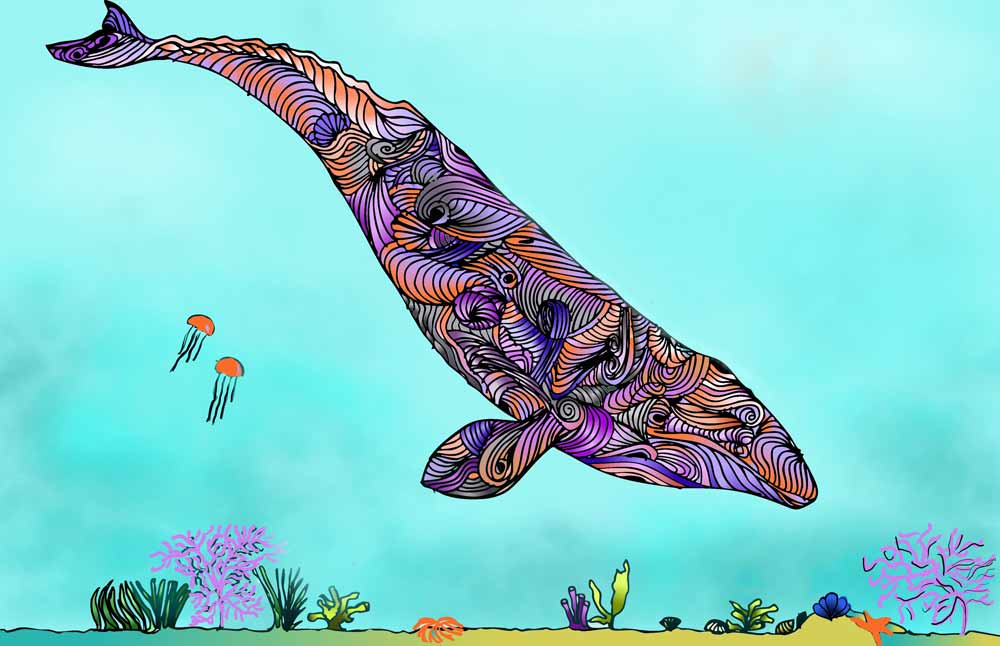
A single gray whale glides over a pastel seafloor, its body woven from ribbons of amethyst, coral, and ink. The swirling motifs are drawn from whale sounds and waveforms—a visual score for a life lived close to the coast. Around it, jellyfish drift and low corals glow, hinting at the near-shore, shallow world where gray whales spend so much time.
Gray whales are the mud sifters of the Pacific. On their epic migration between Baja’s calving lagoons and the Arctic/Bering feeding grounds, they roll through sandy shallows, vacuuming amphipods and other invertebrates. That coastal lifestyle brings them close to people—and into danger. Recent years have seen a dwindling trend, with more than 100 gray whale deaths reported along the Pacific coast in 2025, including 24 in San Francisco Bay. Causes are mixed—ship strikes, entanglement, malnutrition, and shifting prey—but each loss underscores how hard the shoreline has become for a coastal whale.
In this piece, the luminous water is hopeful, but the patterned scars are not accidental: they echo the scratches and barnacle maps many grays carry from a lifetime of close calls. The whale’s downward turn becomes a quiet vow—that we can slow ships, clear lines, and protect feeding corridors—so the song written across its body continues, unbroken, along our shared coast.
Gray Whale Facts (quick hits)
Species: Eschrichtius robustus — the only living member of its family.
Size/Lifespan: 40–49 ft (12–15 m), 30–40,000 lb (14–18 t); 50–70 years.
Look: Mottled gray with barnacles & whale-lice, low bushy blow, no dorsal fin—a low knuckle with bumps.
Feeding: Bottom-feeder with short, coarse baleen; suctions sediment and filters prey, often favoring one side.
Migration: Among the longest of any mammal—10,000–12,000+ miles round-trip. A subset (the Pacific Coast Feeding Group) summers along the Pacific Northwest/BC/northern California near shore.
Calves: 14–16 ft at birth; nurse ~6–8 months while migrating north with mom.
Sound: Mostly low-frequency knocks, rumbles, and pulses (tens to a few hundred Hz) used for contact in turbid water.
Conservation (what’s being done & how to help)
Slow ships: Seasonal/dynamic 10-knot slowdowns and re-routing reduce strike risk (California coast & SF Bay approaches).
Real-time alerts: Acoustic buoys, aerial surveys, and community reports flag whale presence so vessels can adjust.
Cutting entanglements: California’s RAMP program times fishery openings/closures, adds weak links and line limits, retrieves lost gear, and trials on-demand/“ropeless” gear.
Disentanglement teams: Trained responders tag, track, and remove gear when safe; necropsies inform prevention.
Quieting the sea: Ports and operators adopt quieter propellers/maintenance and encourage slower speeds; boater education reduces harassment.
Habitat care: Mexico protects Ojo de Liebre, San Ignacio, Magdalena lagoons; kelp/eelgrass restoration supports near-shore feeding spots in the Pacific Northwest.
What you can do: Boat ≤10 knots and ≥100 yd from whales; report entanglements/strikes; support fisheries testing on-demand gear and shippers in speed-reduction programs; back restoration and response groups.