


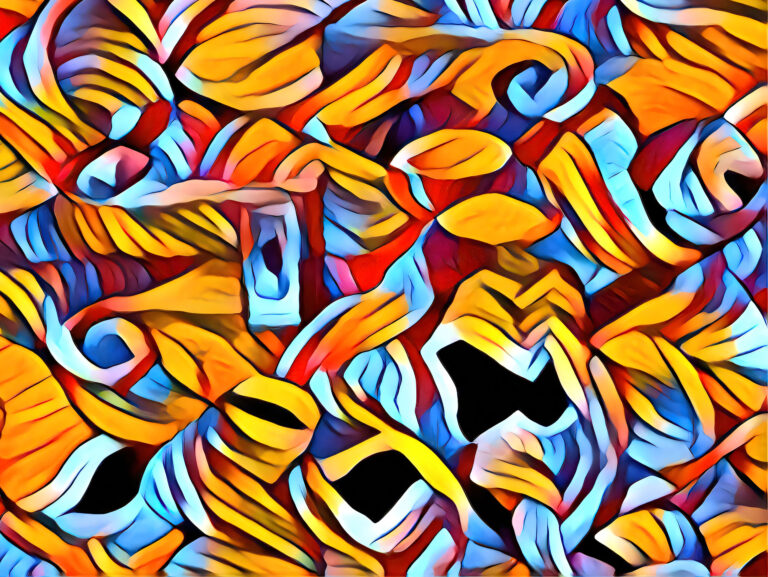

This vibrant abstraction bursts with warm oranges and sunlit yellows, braided with amber and rust. Fluid, organic shapes twist and undulate like rolling surf or molten currents, creating a sense of constant motion. As you look longer, eye- and mask-like forms surface from the swirls—enigmatic glances that deepen the mystery and pull you into the layered textures.
The piece is inspired by whale sound waves and their spectrograms. A spectrogram is a visual portrait of sound: time runs left to right, frequency rises from low to high, and intensity appears as color or brightness. Humpback phrases, for example, trace ladders, ribbons, and pulses across that map; clicks and moans become streaks, arches, and glowing bands. I translate those patterns into paint—stretching tones into curves, letting crescendos flare into bright fields, and allowing silence to settle as deep shadow.
Here, the colors blend and collide to generate depth, as if the viewer is being drawn into a chamber of living sound. The result is a harmonized field of energy and movement—an abstract echo of the ocean’s choir—inviting you to read the image the way whales read the sea: by feeling the rhythm, following the lines, and discovering the hidden eyes that listen back.
https:?//orangeorca.art
What is a spectrogram?
A spectrogram is a visual representation of how a sound’s energy is distributed across frequencies over time.
Axes: time (x-axis) vs. frequency in hertz (y-axis); color/brightness shows amplitude or power (often in dB).
How it’s made: the audio signal is split into short, overlapping time windows and a short-time Fourier transform (STFT) (or similar method) is applied to each window to estimate its spectrum. Stacking those spectra side-by-side makes the image.
Trade-off: Short windows give better time resolution but poorer frequency resolution; longer windows do the opposite. Choice of window type, length, and overlap sets what details you can see.
Why use spectrograms for whale sounds?
Spectrograms turn underwater audio into measurable, comparable patterns, which helps scientists and artists alike.
Identify species & call types: Different whales occupy distinct bands and shapes (e.g., humpback songs with sweeping harmonics; blue/fin infrasonics at 10–40 Hz; toothed-whale clicks as vertical, broadband pulses).
Study behavior: Track song structure, sequences, and rhythm, locate feeding/communication calls, and measure inter-click intervals in echolocating species.
Monitor populations: Long-term “acoustic presence” (who is there and when) can be estimated from automatic detection of spectrogram patterns.
Map movements & habitat use: Relate calling activity to season, location, prey and environmental conditions.
Quantify noise impacts: Measure masking from ships or seismic sources by comparing whale-call energy against background noise in the same frequency bands.
Automated detection/AI: Spectrograms are image-like, so machine-learning models can be trained to spot calls across huge datasets.