

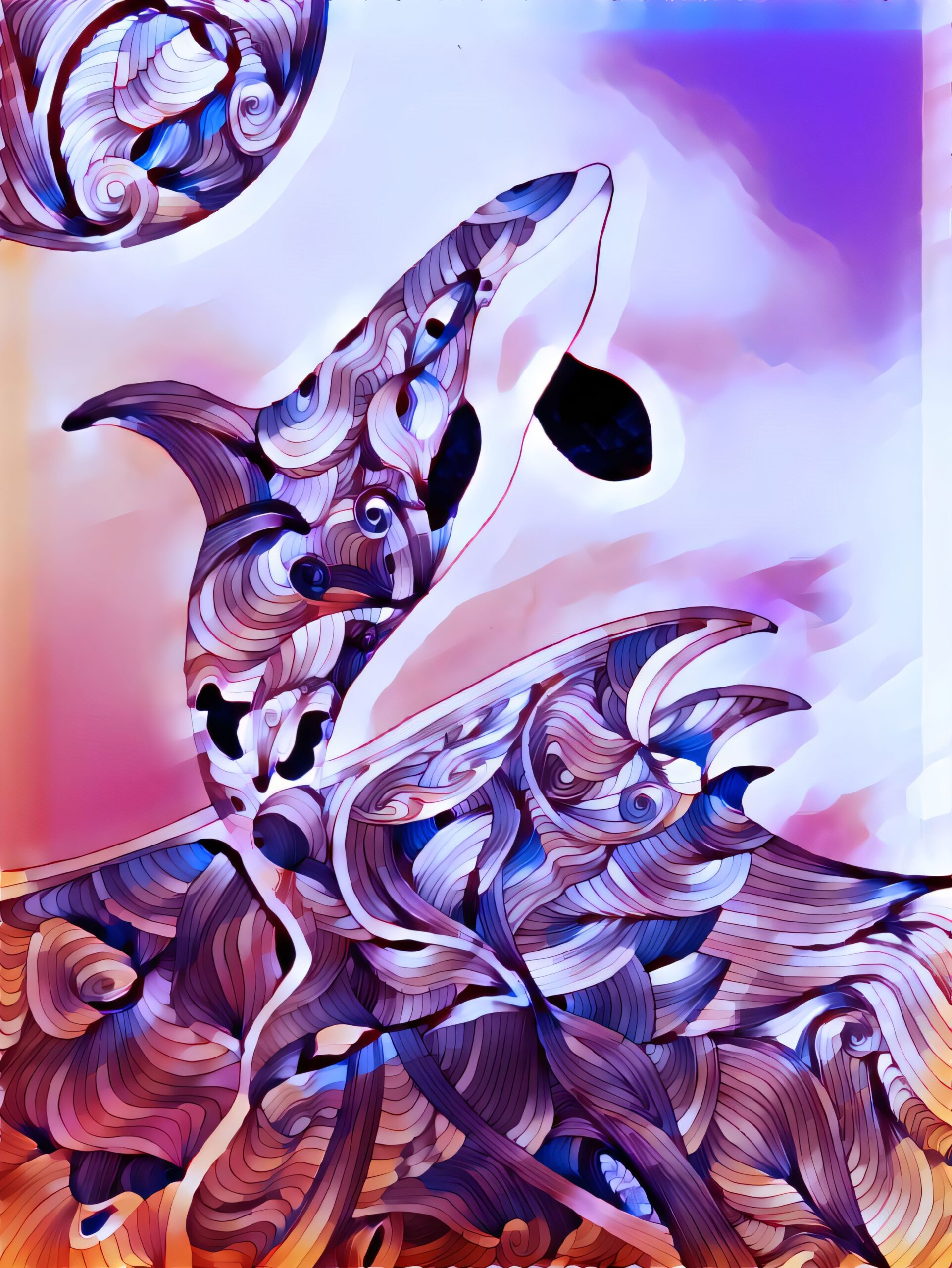

“Brave Little Hunter in Zeballos” is a poignant and evocative artwork capturing the resilience and spirit of a young orca who faced adversity. Inspired by the real-life story of an orca calf who lost her mother in late March 2024 and became trapped in Zeballos, the piece renders her struggle and ascent through intricate lines and swirling patterns in shades of blue, purple, and pink. The central figure, gracefully leaping toward the sky, embodies a journey of survival and hope, while the full moon and rising tides in the background mark her late-April liberation—honoring both the power of nature and the strength of the orca’s spirit.
Beneath that emotion lies the deep family fabric of orca life. Orcas live in matrilineal, matriarchal pods—often five to eight individuals—led by the eldest mother. Based on current research, the length of time a calf “needs” to stay with its mother ranges from several years to, in many cases, an entire lifetime. In the first 1–2 years, a calf is completely dependent: it nurses on the mother’s high-fat milk to build insulating blubber and withstand cold seas. After weaning, a multi-year learning phase begins; the calf remains socially and nutritionally tied to its mother as she teaches essential skills—how to hunt, what to eat, where to travel, and how to communicate. For roughly the first five years, the calf is in a constant state of learning.
In many well-studied populations (such as the Pacific Northwest’s resident killer whales), these bonds are lifelong. Both sons and daughters typically remain with their mother’s pod for life—hunting, traveling, and socializing as a tight-knit family. Remarkably, adult sons often remain highly dependent: mothers share food with them and support them in encounters, measurably improving the sons’ survival. This long-term care can be so intensive that it may reduce a mother’s chances of having another calf—a profound testament to matriarchal investment and cultural continuity.
By situating the young orca’s story within this living lineage—knowledge passed from elder to youth, care extended across decades—the artwork becomes both tribute and testimony: a visual hymn to bravery, family, and the ancestral guidance that carries a calf from peril toward freedom.